Every week someone sends me a headline claiming AI search has passed Google. It hasn’t. Not by any count I trust.
Google still handles roughly nine out of ten searches worldwide, according to StatCounter. In the U.S., AI chatbots account for a fraction of one percent of referral traffic to websites. If you’re measuring by volume, Google isn’t close to losing.
So why does it feel like everything changed? Because something did. It just isn’t the scoreboard.
The numbers miss most of what’s happening
Most AI search never leaves the chat. Someone asks ChatGPT which builders in their area do custom homes, gets a shortlist of three, and calls one. No click. No referral. Nothing shows up in your analytics. ChatGPT alone reported more than a billion weekly users this fall. Those conversations are happening whether you can see them or not.
And here’s the part most of the “AI vs. Google” takes skip: the biggest AI search engine is Google. Through AI Overviews, Google now serves more AI-generated answers than anyone else. The real story isn’t AI replacing Google. It’s Google becoming AI search, while ChatGPT, Gemini, Claude, and Perplexity build a second front door.
AI Search vs. Google: Wrong Question
How the two actually differ
Traditional search: you type a few words, get a page of links, and do the reading yourself.
AI search: you ask in full sentences, follow up, push back, and get one synthesized answer. Sometimes with sources. Sometimes with mistakes stated confidently.
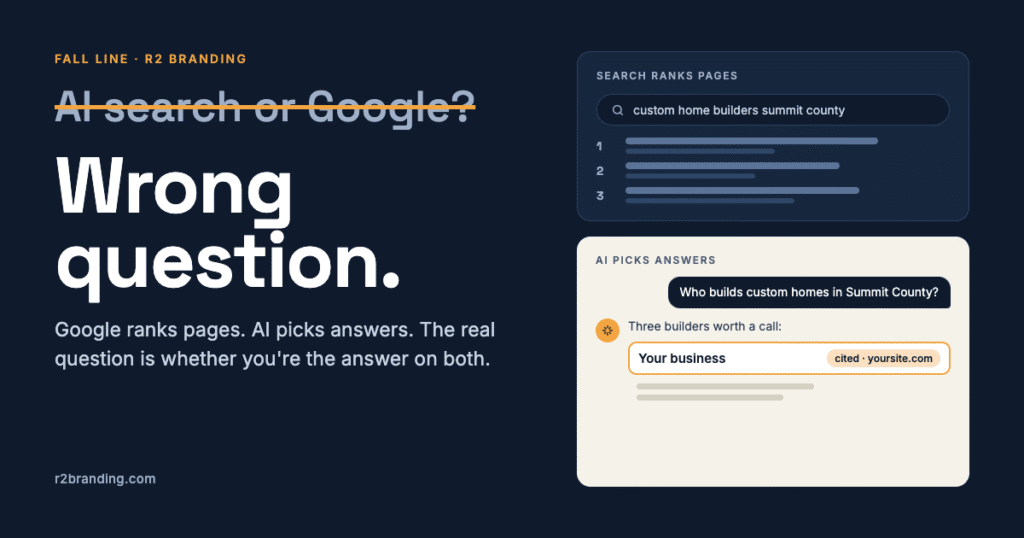
That difference changes how your business gets found. Google ranks pages. AI picks answers.
What this means for your business
Ranking is no longer the finish line. Being cited is. AI tools pull from sources they can understand and trust. If your website is vague about who you serve, what you do, and where, you won’t get named in the answer. Your competitor with the clearer site will.
Fewer clicks, better clicks. The studies are all over the map, but most find visitors arriving from AI answers convert better than standard organic traffic, often by a wide margin. That makes sense. The AI already did the shortlisting. At least one large ecommerce study found the opposite, so don’t take anyone’s average as yours. Measure your own.
Google is not optional. Local search, Maps, reviews, and your Google Business Profile still run the show for anyone with a service area or a storefront. Walking away from Google to chase AI would be a mistake.
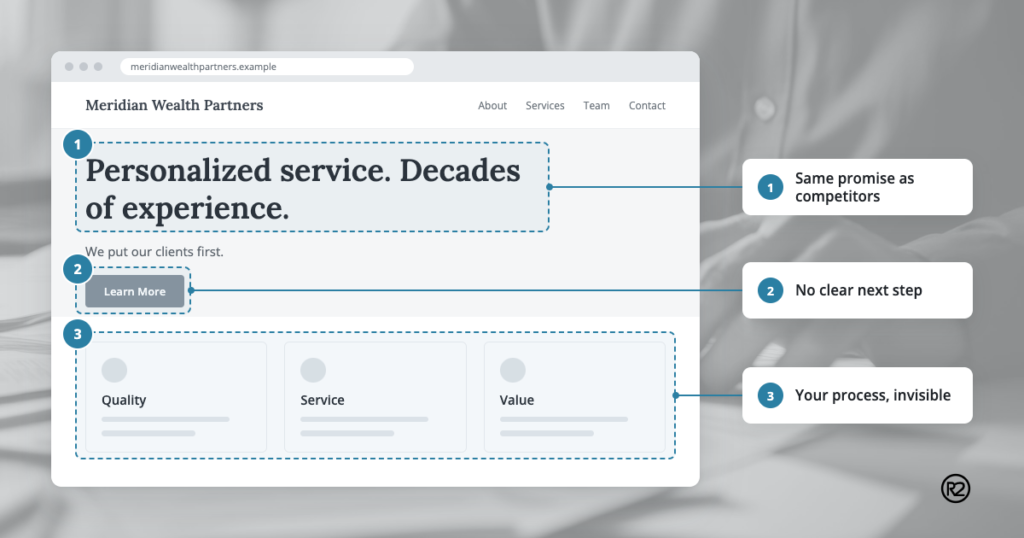
Your website is now a briefing document for a machine. Plain statements beat clever ones. “We build custom homes in Summit County” gets cited. “Crafting spaces where life happens” doesn’t.
What I’d do this quarter
1. Ask the machines about yourself. Put the questions your customers ask into ChatGPT, Gemini, Claude, and Perplexity. Do you show up? What do they say? Is it accurate?
2. Tighten your site copy. Who you serve, what you do, where you do it, and proof. Stated plainly, on pages that load.
3. Keep Google sharp. Current Business Profile, fresh reviews, accurate hours and services.
4. Track AI as its own channel. Set up AI referrals as a separate source in GA4. Most marketers still don’t, which means most are guessing.
The question isn’t AI or Google. It’s whether you’re the answer on both.
Let’s see what AI says about your business. No charge. No obligation.
|
|