Here’s a quick test. Take your last LinkedIn post or blog article, remove your name, and show it to a longtime client. Would they know you wrote it?
For a growing number of businesses, the honest answer is no. AI tools have made content fast and cheap to produce. They’ve also made a lot of it sound exactly alike.
Why AI content all sounds the same
AI writing tools learn from enormous amounts of available text. Ask one for a post about leadership or customer service, and it gives you the most typical version of that post. It’s competent, polished, and safe.
That’s the problem. “Typical” is the opposite of memorable. When thousands of businesses ask the same tools similar questions, they get similar answers. You’ve seen the results: posts that open with “In today’s fast-paced world,” promise to “unlock potential,” and finish with a question nobody answers.
None of it is wrong. It just isn’t anyone.
What your voice actually is
Your voice isn’t a tone setting. It’s made of things no tool can invent for you:
- Stories only you have. The client situation you handled, the mistake you learned from, the call that changed how you work.
- Opinions you’ll stand behind. The common advice you disagree with, and why.
- The way you actually talk. The phrases your clients hear from you in meetings, not the ones a template suggests.
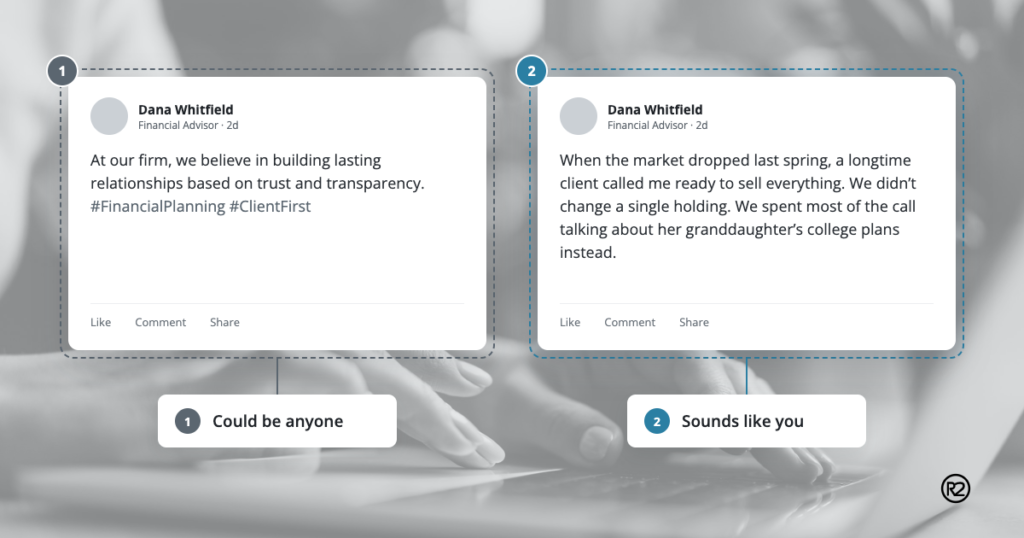
Here’s an illustration. A financial advisor’s post, the typical way:
At our firm, we build lasting relationships founded on trust and transparency.
And the same idea in a real voice:
When the market dropped last spring, a longtime client called me ready to sell everything. We didn’t change a single holding. We spent most of the call talking about her granddaughter’s college plans instead.
The first sentence could belong to any firm in the country. The second could only come from someone who’s been in that room.
Using AI without losing your voice
I use AI every day in my ghostwriting work, and I’m not suggesting you avoid it. The question is who’s making the decisions.
When AI writes from a blank prompt, it fills the space with the average. When it works from your stories, opinions, and way of speaking, it becomes a tool to get your thinking onto the page faster.
That’s how I approach it. I work across several AI platforms, each with different strengths, and none of them gets the final word. Decades of marketing judgment decide what stays, what goes, and what sounds like you. The tools handle speed. The judgment handles everything that makes the content worth reading.
It’s the same answer to the question I hear most often: “Why not just use AI myself?” You can. But the tool can’t supply your stories, and it can’t tell when a sentence has stopped sounding like you.
Try the test
Pull up your last three posts. For each one, ask: could a competitor publish this tomorrow with only the name changed? If the answer is yes, your content is costing you time without building trust.
If you’d like a second set of eyes, request a free Voice Audit. Send me what you’re publishing now, and I’ll show you where the voice drifts, where it sounds generic, and what’s worth keeping. I review every request personally, and you’ll hear back from me within three business days.